Happening Now
Sanderson’s TSA Line Will Be Brutal
May 7, 2026
by Jim Mathews / President & CEO
I want to say that one immediate reaction to the recent discussion around train security is sort of understandable, I guess: if someone dangerous boarded an Amtrak train carrying weapons, why not simply screen passengers the way airports do?
But the answer is resoundingly simple: because passenger rail isn't aviation.
And trying to turn it into aviation would likely damage many of the very things that make rail transportation work in the first place.
Let me say it here, plainly: installing TSA-style screening for Amtrak trains is just sheer boobery. It’s a bad answer. And it’s the wrong answer.
Some of the more breathless commentators out there seem to imagine Amtrak as a system of giant terminals: Washington Union Station, Penn Station, LA Union Station, complete with controlled access points, security perimeters, and room for TSA checkpoints.
Reality? Amtrak serves more than 500 destinations across the country. Roughly 380 of those stations are entirely unstaffed. Some are little more than small platforms or modest shelters alongside the tracks. Rail passengers know them affectionately as “Amshacks,” though in some cases even “shack” may be generous.
Ever been to Sanderson, Texas? Passengers board the westbound Sunset Limited from a tiny open-air shelter beside the tracks in the middle of the Chihuahuan Desert. Really? TSA screening? Can you even imagine what that looks like, let alone what that costs? Nobody is building a miniature TSA terminal there anytime soon.
And Sanderson is far from unique.
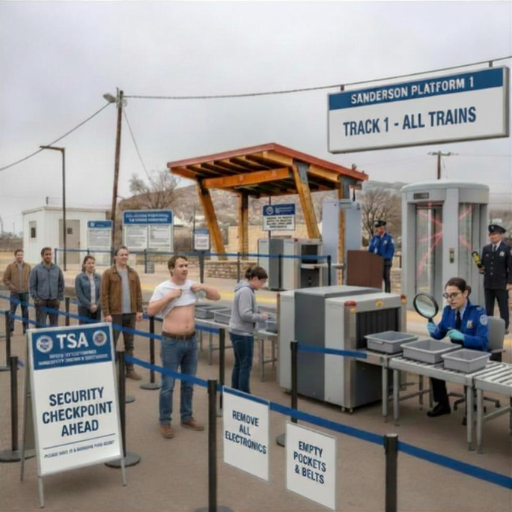
Ignoring that operational reality during this recent debate risks importing aviation assumptions into a transportation mode that functions fundamentally differently. Airlines move passengers through a relatively small number of heavily controlled facilities. Passenger rail operates as an open-access network spread across hundreds of communities, many with minimal infrastructure and low passenger volumes. And that’s a feature, not a bug.
Aviation-style universal screening isn’t just expensive on a rail network. In many places, like Sanderson, Tex., or any of the other unstaffed locations, it’s utterly impossible.
Even more important, it’s not obvious it would even produce proportionate benefits.
There’s good news that’s often overlooked in the heat of these conversations: Amtrak remains a remarkably safe environment overall. According to the latest annual report from the Amtrak Police Department, overall crime aboard the system remains comparatively low and several major categories of incidents have declined in recent years.
Now, that doesn’t mean we should dismiss security concerns. We were among the very first organizations in Washington to press for a Federal standard that treats assaults against Amtrak crew members as a Federal offense, just as it is today for assaults on airline cabin crews. And we’re still pushing for that kind of protection. Security concerns are important and real. But they should be evaluated proportionately and intelligently rather than emotionally, something which Amtrak Police have been genuinely proactive in doing, leading the way in many cases.
Fortunately, there are already approaches available which are far more sophisticated, and arguably more effective, than simply trying to turn every train station into an airport checkpoint.
Those strategies include stronger intelligence-sharing between agencies, behavioral threat detection, visible but flexible police presence, better frontline employee reporting systems, targeted random screening operations, expanded camera coverage, and rapid-response coordination with local law enforcement.
In other words: security measures tailored to how rail actually works.
I’ll admit that approach lacks the visible drama of long TSA lines: double-wanding Grandma and her walker, drooping belt-less slacks, discarded water bottles, and shoe-removal rituals. Oh and let's not forget, Grandma could have avoided some of that indignity if she just paid a couple of hundred bucks for PreCheck or Clear or Global Entry. Gotta pay your share!
But effective security and visible security aren’t always the same thing. Passenger rail occupies a delicate middle ground in American life. Trains are public spaces. They are open spaces. They are shared civic spaces. That openness is not a design flaw, but is instead one of rail’s greatest strengths. Our challenge is how to preserve that openness while managing risk intelligently.
No transportation system carrying millions of passengers across thousands of miles can ever be made perfectly risk-free without ceasing to function as transportation. The goal shouldn’t, and can’t, be theatrical perfection. It should be practical resilience.
And in the case of passenger rail, preserving the openness and accessibility that make the system useful in the first place is central to the mission.
"The Rail Passenger Association's recognition of the essential work done by SMART-TD members aboard Amtrak during this difficult period is appreciated. The Golden Spike Award serves as a testament to the compassion and dedication our conductors, assistant conductors and other workers exhibit constantly through times both ordinary and extraordinary."
Jeremy Ferguson, SMART-TD President
December 21, 2021, on the Association awarding its 2021 Golden Spike Award to the Frontline Amtrak Employees.
Comments